
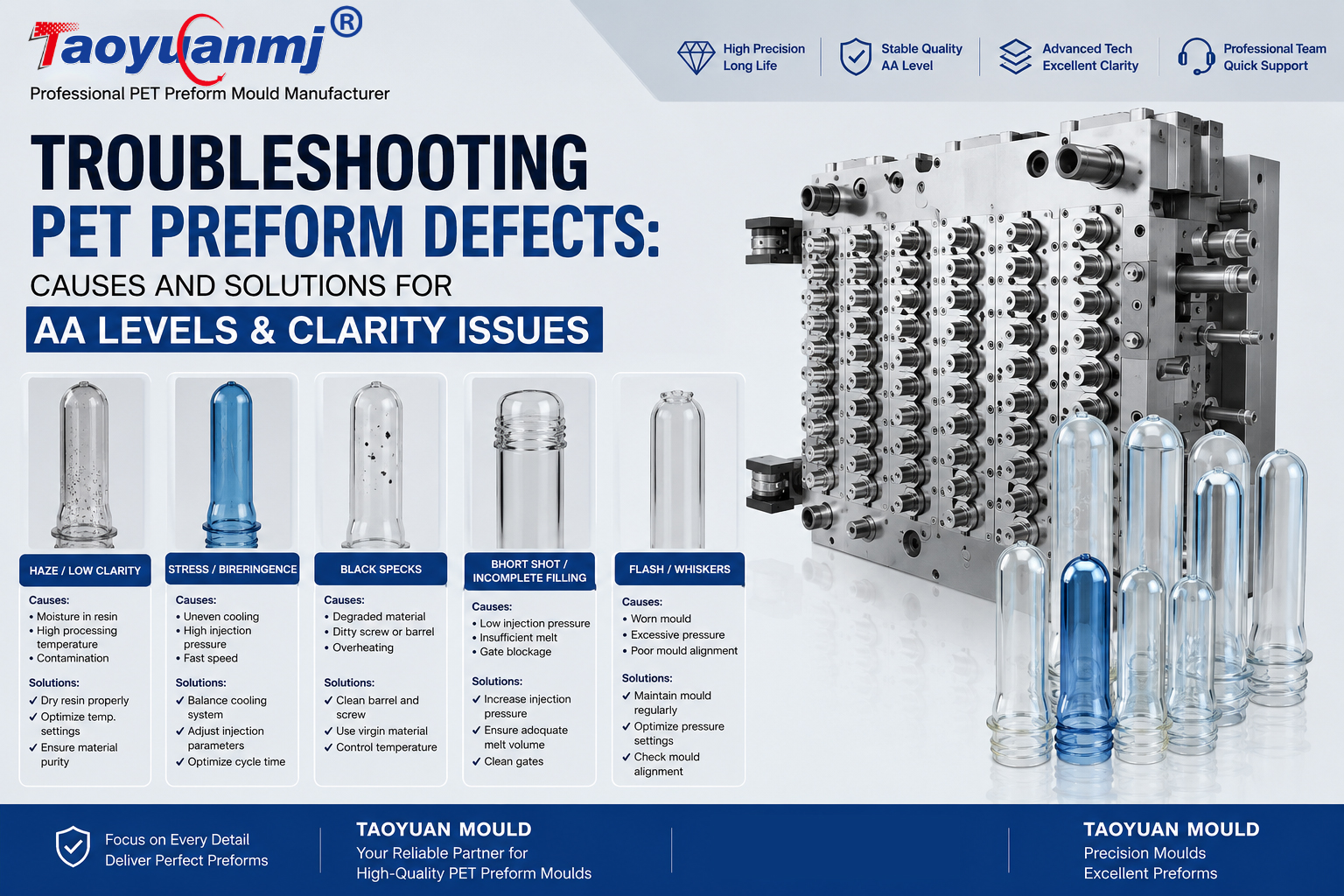
Troubleshooting PET Preform Defects: Causes and Solutions for AA Levels & Clarity Issues
In the high-speed manufacture of Polyethylene Terephthalate (PET) preforms—especially for beverage, mineral water, and edible oil packaging—achieving zero-defect production is paramount. Two of the most critical quality challenges faced by packaging engineers and plant managers are elevated Acetaldehyde (AA) levels and poor optical clarity (haze/crystallization).
At Taoyuan Mould, with decades of expertise in precision PET preform mold engineering, hot runner optimization, and cooling system integration, we systematically analyze the root thermal, mechanical, and processing causes of these defects. This guide outlines practical diagnostic steps and mold-level engineering solutions to ensure your production meets international quality standards.
1. Acetaldehyde (AA) Levels: Root Causes and Engineering Fixes
Acetaldehyde is a natural thermal degradation byproduct of PET resin. High AA levels alter the taste profile of delicate beverages like pure water, making AA control a top priority for premium bottling operations.
Primary Causes of High AA Levels
- Excessive Thermal Shear & Shear Rate: Narrow runner diameters, improper gate geometries, or sharp turns in the hot runner system create high friction, thermally degrading the melt.
- Hot Runner Hot Spots: Uneven heating zones or uncalibrated PID controllers in the manifold lead to localized overheating above 290°C.
- Long Residence Time: Oversized barrels or unbalanced hot runner channels hold the melt too long at elevated temperatures.
- Improper Screw Design & Back Pressure: Excessive back pressure generates excessive mechanical shear heat during plasticization.
Taoyuan Mould's Engineering Solutions for AA Control
To keep AA levels well below strict beverage industry specifications (e.g., < 3.0 ppm for water preforms), we implement targeted mold designs:
| Defect Driver | Root Cause | Taoyuan Mould Solution |
|---|---|---|
| High Shear Stress | Small valve gate diameter or sharp flow transitions | Optimized valve gate orifice sizing and naturally balanced, highly polished hot runner flow channels. |
| Thermal Overheating | Manifold temperature spikes / hot spots | Advanced multi-zone electric heating with balanced thermocouple placement to prevent localized hot spots within ±1°C. |
| Melt Stagnation | Dead zones in hot runner manifolds | Computer-simulated rheological channel designs with smooth radii to maintain uniform melt velocity. |
2. Preform Clarity and Haze: Overcoming Crystallization & Moisture Defects
A crystal-clear PET preform indicates an amorphous molecular structure. Haziness—whether uniform or localized—signals unwanted crystallization or thermal/moisture contamination.
Types of Clarity Defects & Diagnostic Guide
A. Thermal / Spherulitic Crystallization (Milky Haze inside Wall)
- Cause: Slow cooling speed while the PET resin passes through its crystallization window (approx. 140°C to 200°C).
- Mold Solution: Upgrade to Taoyuan Mould's High-Efficiency Core & Cavity Cooling System. By utilizing high-thermal-conductivity copper alloys (e.g., BeCu) at core tips and implementing high-flow turbulent water channels (Reynolds Number > 4000), heat extraction is accelerated, locking in the amorphous state.
B. Moisture Haze (Overall Dullness or White Streaks)
- Cause: Inadequate resin drying prior to injection, causing hydrolytic degradation during melting.
- Solution: Ensure raw PET resin moisture content is maintained below 50 ppm (0.005%) using a dehumidifying dryer operating at -40°C dew point.
C. Gate Area Crystallization (White Rings near Base)
- Cause: Insufficient cooling around the neck ring or valve gate region, or excessive holding time keeping the gate area hot.
- Mold Solution: Independent gate cooling circuits with dedicated chilled water loops directly surrounding the valve gate insert.
3. Systematic Troubleshooting Matrix for Injection Operations
When encountering AA or clarity issues during production, follow this step-by-step optimization sequence:
- Dryer Audit: Verify PET dew point (< -40°C) and drying temperature (160°C–180°C for 4–6 hours).
- Temperature Profile Reduction: Lower barrel temperatures progressively by 5°C increments, starting from the rear zones.
- Cycle Time & Cooling Water Check: Confirm cooling water temperature is 8°C–12°C with adequate flow rate and pressure (> 4 bar).
- Hot Runner Calibration: Inspect manifold heaters and thermocouples for drift or aging.
- Mold Maintenance: Clean core/cavity vents and remove scale deposits inside cooling channels using mold descaling agents.
Why Partner with Taoyuan Mould for PET Preform Solutions?
Eliminating AA and clarity defects requires a total system approach combining premium steel selection (S136 / 1.2083 stainless steel), ultra-precise CNC machining, and state-of-the-art hot runner technology.
As a specialized manufacturer of multi-cavity PET preform molds (up to 144 cavities), Taoyuan Mould provides:
- Custom Hot Runner Systems: Engineered specifically for low shear stress and minimal AA generation.
- Interchangeable Mold Components: High-precision machining ensures neck splits, cores, and cavities are fully interchangeable for rapid maintenance.
- Turnkey Process Optimization: On-site and remote engineering support to optimize injection settings, cycle times, and preform weight consistency.
Contact Taoyuan Mould today to evaluate your current preform mold performance or request a custom mold quotation tailored to your production goals.