
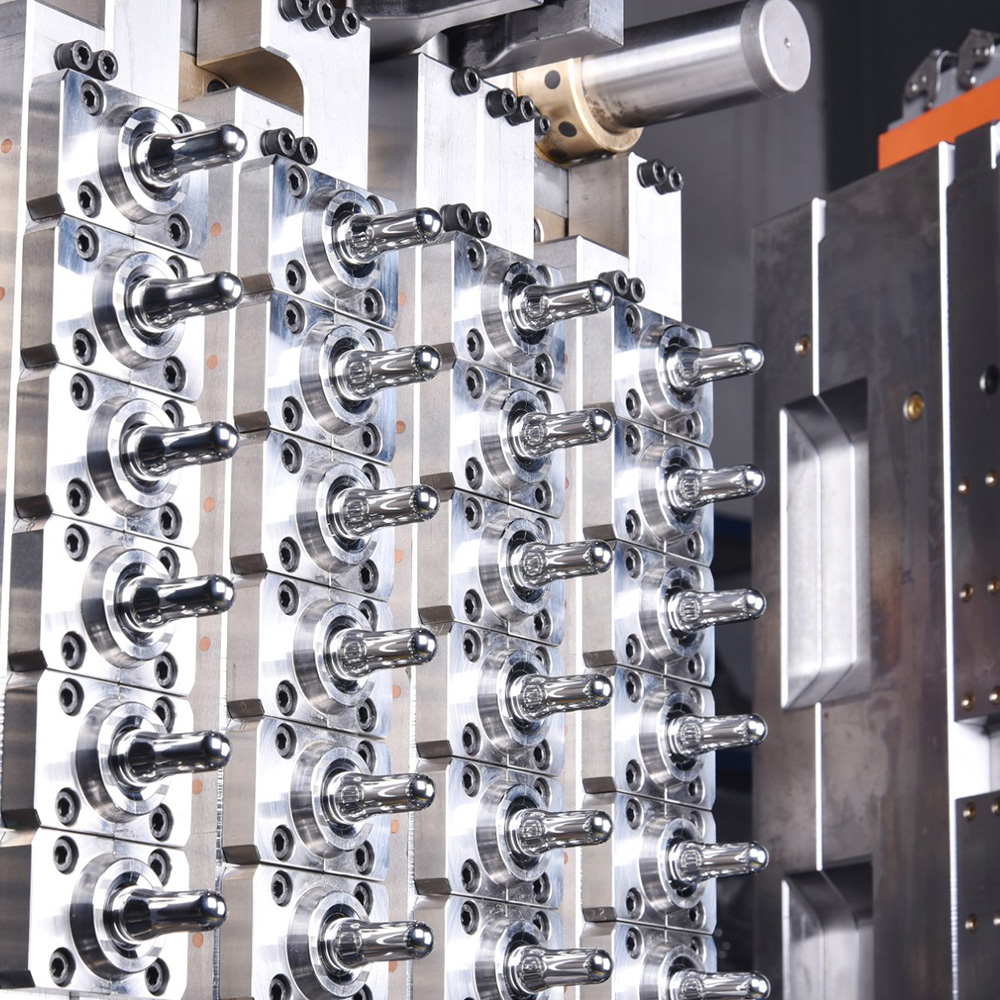
Why Mold Steel Selection Matters: S136 vs P20 for PET Preform Molds
A Metallurgy and Engineering Analysis by pet-molds (PET-MOLDS CO., LTD.)
Executive Summary
In high-volume injection molding, the foundation of tooling longevity, cycle efficiency, and part quality lies in material science. Choosing the appropriate mold steel configuration is the single most critical decision during the engineering phase of a PET preform mold. While various steel grades exist in the global market, the choice often narrows down to P20 pre-hardened steel and S136 high-chromium stainless steel. As a premier Chinese manufacturer of high-precision preform tooling and an industry-recognized professional closure mold solution expert, pet-molds presents a deep technical comparison of S136 versus P20 steels to guide global packaging procurement teams toward maximizing asset lifespan and minimizing operational defects.
1. Metallurgical Profiles: S136 vs. P20
To understand how these materials perform under industrial stress, we must evaluate their baseline chemical compositions and mechanical properties after processing.
A. P20 Steel (DIN 1.2311 / 1.2738)
P20 is a versatile, low-alloy pre-hardened plastic mold steel. Supplied typically at a hardness of 28–32 HRC, it requires no subsequent heat treatment after CNC machining. While it offers excellent machinability and cost-effectiveness for low-to-medium volume general plastic parts, its structural limitations become apparent when subjected to the extreme pressures and corrosive micro-environments inherent to PET injection molding.
B. S136 Stainless Steel (DIN 1.2083 / AISI 420)
S136 is a premium martensitic stainless chromium steel optimized for plastic molds requiring high purity, exceptional corrosion resistance, and superb mirror-polishability. Following vacuum gas quenching and tempering by pet-molds, the working components achieve a uniform hardness profile of HRC 48–52. This dense microstructure effectively resists both mechanical wear and chemical attack over millions of injection cycles.
2. Mechanical Wear and Lifetime Projections
The abrasive nature of flowing PET resin at high pressures wears down mold surfaces over time. According to Archard’s wear formulation, sliding wear volume (W) is inversely proportional to the material hardness (H):
Archard's Mechanical Wear Equation:
$$W = K \frac{P \cdot L}{H}$$
Where K is the wear coefficient, P is the normal load, and L is the sliding distance. Because S136 (HRC 48-52) possesses a significantly higher hardness matrix than P20 (HRC 30), its rate of mechanical erosion is dramatically lower, effectively granting S136 cavities a production life exceeding 3 to 5 million cycles, compared to P20 molds which often degrade before reaching 1 million cycles.
3. Technical Comparison Matrix
The operational and financial performance of these two steel grades reveals the distinct advantages of investing in high-grade metallurgy:
| Engineering Property | P20 Pre-Hardened Steel | S136 Hardened Stainless Steel (pet-molds Standard) |
|---|---|---|
| Core & Cavity Hardness | HRC 28 - 32 | HRC 48 - 52 (Vacuum Heat-Treated) |
| Corrosion Resistance | Low; highly prone to oxidation from chilled water condensation. | Exceptional; completely rust-proof under intensive cooling environments. |
| Mirror Polishability | Moderate; surface roughness values restricted by alloy inclusions. | Superb (Ra ≤ 0.02 μm); enables clean, scratch-free preform ejection. |
| Thermal Conductivity | Good general heat transfer properties. | Optimized through precision 3D conformal cooling configuration. |
| Tooling Lifetime (Guaranteed) | < 800,000 shots | > 3,000,000 to 5,000,000 shots |
4. Critical Impact Factors in High-Speed Production
A. Corrosion and Condensation Management
PET preform molds utilize high-flow, chilled water systems running at temperatures as low as 8°C to minimize cooling cycles. When running in humid factory environments, heavy water condensation forms instantly on the mold faces during mold-open phases. P20 steel rusts rapidly under these conditions, causing localized pitting on the parting lines and inside the cooling paths, which slows down heat transfer. S136 remains entirely rust-proof, maintaining clean, unpitted surfaces and uninterrupted thermal transfer lines over years of continuous deployment.
B. Defect Prevention Through Polish Retention
To ensure flawless preform ejection by robotic take-out plates, cores and cavities must maintain a mirror finish. P20 soft surfaces scratch easily during manual cleanings or from sliding friction against rigid preforms, resulting in vertical score lines and aesthetic rejections on blown bottles. Hardened S136 preserves its mirror-smooth finish indefinitely, ensuring scratch-free preforms and maintaining a stable, low coefficient of friction during the rapid mechanical ejection sequence.
5. The Synergistic Connection with Professional Closure Engineering
At pet-molds, our extensive background as professional closure mold solution experts shapes our material selection criteria. A secure, leak-proof bottle closure depends entirely on the micro-dimensional repeatability of the preform thread and neck finish.
If a manufacturer uses low-grade P20 steel for the neck split inserts, the constant clamping impact forces will gradually compress and distort the thread profiles over hundreds of thousands of cycles. By strictly implementing vacuum-hardened S136 stainless steel for all neck rings, thread dimensions remain unchanged across millions of runs. This guarantees that your plastic caps will thread and seal with flawless mechanical consistency on high-speed downstream automated filling lines.
Conclusion
While P20 steel presents a lower initial upfront cost suitable for short prototyping trials, it represents an operational bottleneck for high-volume, continuous beverage packaging operations. Hardened S136 stainless steel stands as the industrial benchmark for high-cavity packaging systems. By eliminating rust risks, retaining an impeccable optical polish, and matching the exact demands of modern capping standards, pet-molds ensures your tooling achieves maximum uptime, ultra-low scrap rates, and the lowest total cost of ownership (TCO).
Contact the engineering division of pet-molds today to review your preform component steel metrics and optimize your injection system architecture.