
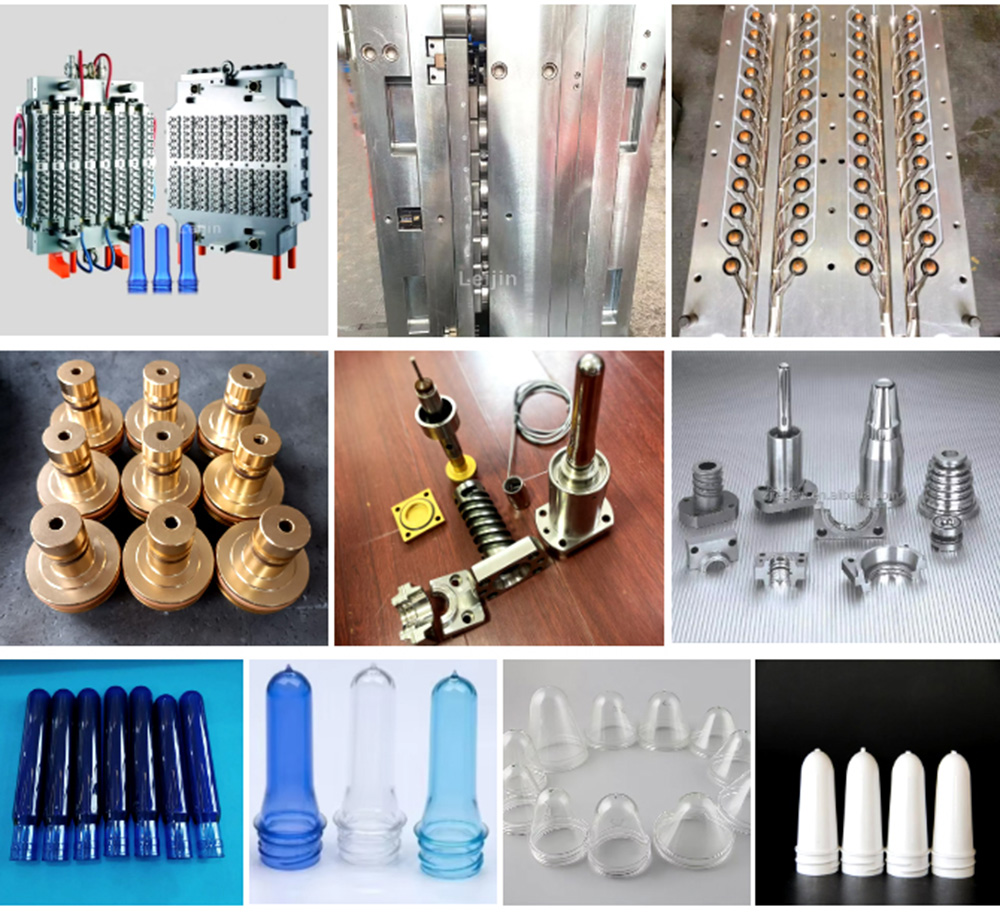
Top 10 Common Defects in PET Preforms and How Precision Mold Engineering Prevents Them
An Advanced Technical Engineering Guide by pet-molds (PET-MOLDS CO., LTD.)
Executive Summary
In the high-speed world of PET bottle manufacturing, preform quality dictates final container integrity, top-load strength, and blowing line efficiency. Even microscopic flaws in the injection-molded preform can translate into burst bottles, aesthetic rejections, or catastrophic line downtime. As a premier Chinese manufacturer specializing in high-precision PET preform molds, pet-molds combines decades of tooling expertise with cutting-edge thermal and mechanical design. This comprehensive technical analysis explores the top 10 common PET preform defects and explains how advanced mold engineering permanently prevents them.
The Top 10 PET Preform Defects & Mold Engineering Solutions
1. Acetaldehyde (AA) Generation and Polymer Degradation
The Defect: Excessive thermal residence time inside the hot runner or barrel causes PET polymer breakdown, releasing acetaldehyde which taints the taste of bottled water and beverages.
Mold Engineering Prevention: At pet-molds, our hot runner systems feature optimized flow channel diameters and balanced residence times, coupled with precise PID thermal zoning that eliminates localized hot spots and prevents polymer stagnation.
2. Wall Thickness Eccentricity (Core Shift)
The Defect: Uneven wall thickness causes unbalanced stretching during stretch blow molding, resulting in weak container walls and burst bottles.
Mold Engineering Prevention: We utilize high-rigidity core guides and precision locking mechanisms, maintaining core-to-cavity concentricity tolerances within ≤ 0.05 mm even under high injection pressures.
3. Gate Vestige Stringing and Freeze-off Issues
The Defect: Stringing or excessive gate vestige at the injection point disrupts downstream stretch blow molding pins and creates aesthetic blemishes.
Mold Engineering Prevention: Our advanced pneumatic valve-gated hot runner designs provide instantaneous mechanical shut-off, keeping gate vestiges under 1.0 mm and ensuring clean, repeatable separation.
4. Crystallization and Haze in Preform Bodies
The Defect: Premature cooling or inadequate thermal transfer leads to localized whitening (crystallization), ruining the optical clarity required for transparent PET containers.
Mold Engineering Prevention: We integrate high-speed 3D conformal cooling channels utilizing corrosion-resistant S136 stainless steel (HRC 48-52) to ensure rapid, uniform heat extraction across every cavity.
5. Flash on the Neck Finish and Parting Lines
The Defect: Excess plastic squeezing out between mold parting surfaces or neck split inserts, which jams capping equipment.
Mold Engineering Prevention: Precision CNC grinding and matched parting-line face milling ensure metal-to-metal sealing under full clamping tonnage, completely eliminating flash.
6. Short Shots and Incomplete Filling
The Defect: Incomplete preform structure due to premature freezing, insufficient injection pressure, or blocked flow channels.
Mold Engineering Prevention: Computational mold-flow simulation is applied during our design phase to balance shear rates and melt viscosity across 48, 72, or 96+ cavities simultaneously.
7. Preform Body Scratches and Ejection Scoring
The Defect: Surface marks or vertical scoring caused by friction during core extraction and robotic take-out.
Mold Engineering Prevention: Polishing core inserts to a mirror finish (Ra ≤ 0.02 μm) combined with specialized surface coatings drastically reduces friction coefficients and eliminates ejection scoring.
8. Moisture-Induced Silver Streaks (Splash Marks)
The Defect: Silvery streaks running along the preform length caused by trapped moisture or volatile gases during injection.
Mold Engineering Prevention: While material drying is handled on-site, our mold designs incorporate micro-venting along the split inserts to allow trapped air and volatiles to escape cleanly without burning the steel.
9. Dimensional Instability and Thread Distortion
The Defect: Warped threads or deformed neck finishes that fail to pass Go/No-Go gauges, causing severe leakage during capping.
Mold Engineering Prevention: As professional closure mold solution experts, pet-molds engineers the preform neck finish and the corresponding cap tooling in unison, guaranteeing exact thread pitch matching and stable thermal release.
10. Internal Residual Stress and Birefringence
The Defect: High internal molecular stress leading to stress cracking and unpredictable shrinkage rates during bottle blowing.
Mold Engineering Prevention: Optimized cooling dynamics and balanced injection speeds ensure uniform thermal contraction, minimizing locked-in residual stress across the preform body.
Why pet-molds is Your Trusted Tooling Partner
Defect-free preforms begin with superior mold design. By integrating high-grade S136 steel, advanced conformal cooling, and rigorous simulation testing, pet-molds delivers high-cavity tooling built for zero-defect operations.
Furthermore, our dual expertise as a premier PET preform mold manufacturer and a professional closure mold solution expert ensures seamless mechanical compatibility between your bottles and caps. Contact our engineering team today to upgrade your production line performance.