
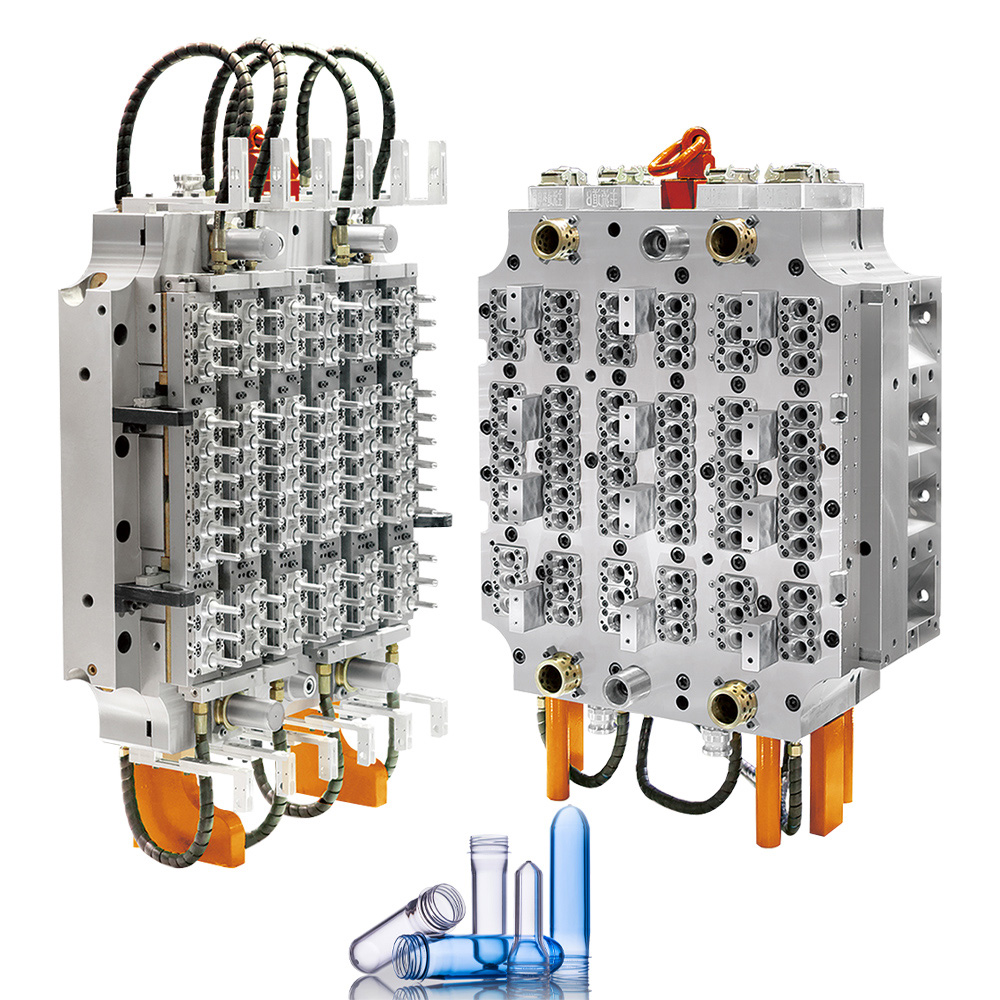
Case Study: Eliminating Short Shots and Flow Marks in a 72-Cavity Preform Mold
An Advanced Engineering Troubleshooting Report by pet-molds (PET-MOLDS CO., LTD.)
Executive Summary
In high-cavity PET preform manufacturing, scaling up to a 72-cavity or 96-cavity production system drastically maximizes throughput, but it simultaneously introduces complex fluid-dynamic challenges. Uneven melt distribution, thermal imbalances, and high shear rates frequently trigger critical molding defects such as short shots and superficial flow marks. This engineering case study details how pet-molds, a premier Chinese manufacturer of high-precision PET preform molds, successfully diagnosed and eliminated chronic short shots and flow marks in a client's 72-cavity system using advanced rheological simulation, hot runner re-balancing, and conformal cooling optimization.
1. The Client's Challenge: Unstable Filling and Aesthetic Rejections
A major international beverage bottler approached our technical division after experiencing severe yield losses on a newly installed 72-cavity preform mold sourced from an alternative tooling supplier. Their production line suffered from two persistent defects:
- Chronic Short Shots: Cavities situated at the extreme outer edges of the hot runner manifold frequently failed to fill completely, resulting in incomplete preform base domes and structural rejection rates exceeding 8.5%.
- Surface Flow Marks and Swirls: Visible wavy flow lines appeared on the middle section of the 24g preforms, which later translated into localized weak spots and optical haze during the stretch blow-molding stage.
These defects crippled plant productivity, forcing operators to run excessive injection pressures and melt temperatures, which inadvertently spiked Acetaldehyde (AA) generation and polymer degradation.
2. Root-Cause Analysis by pet-molds Engineering
Our senior tooling engineers performed a comprehensive multi-point audit, utilizing high-speed pressure transducers, thermal imaging, and 3D mold-flow rheological simulations. The investigation revealed three fundamental structural flaws in the original mold design:
A. Manifold Thermal Asymmetry
The original hot runner manifold suffered from temperature variances exceeding 7°C between the central and peripheral nozzles. This thermal imbalance caused inconsistent melt viscosity across the 72 cavities.
B. Shear Stress and Pressure Drop
The runner channel diameter was improperly proportioned relative to the shot weight, creating excessive shear heating and localized pressure drops before the resin reached the outer gate tips.
C. Inadequate Venting and Air Trapping
The parting line split inserts lacked proper micro-venting, trapping compressed air pockets that resisted complete cavity filling and caused surface flow marks.
3. The Custom Engineering Solution
To permanently resolve these issues, pet-molds re-engineered the tooling system using our proprietary high-precision optimization protocol:
| Optimization Area | Original Defective Design | pet-molds Re-Engineered Solution |
|---|---|---|
| Hot Runner Thermal Control | Standard open-loop heating with ±7°C variance. | Multi-zone closed-loop PID control keeping melt variance within ±0.5°C. |
| Valve-Gate & Flow Balance | Unbalanced natural balance leading to outer starvation. | Computer-optimized rheological flow channels with precise valve-gate timing. |
| Mold Steel & Cooling | Standard P20 steel with linear drilled cooling lines. | Hardened S136 stainless steel (HRC 48-52) with 3D conformal cooling. |
| Ventilated Parting Lines | Zero functional venting; trapped air resistance. | Precision-ground micro-vents (≤ 0.015 mm) on neck split inserts. |
Furthermore, as professional closure mold solution experts, we ensured that the redesigned preform neck interface maintained absolute dimensional harmony with the client's high-speed cap application machinery, guaranteeing zero thread distortion during rapid ejection.
4. Results and Production Impact
Following the integration of the re-engineered components and mold optimization by pet-molds, the client achieved immediate, quantifiable operational improvements:
- Zero Short Shots: All 72 cavities achieved 100% complete and uniform filling, reducing rejection rates from 8.5% down to less than 0.1%.
- Flawless Surface Finish: Flow marks and optical haze were completely eliminated, restoring crystal-clear transparency and uniform wall thickness eccentricity (≤ 0.03 mm).
- Cycle Time Reduction: Enhanced thermal dissipation through S136 stainless steel and conformal cooling shaved 1.4 seconds off the total cycle time, boosting overall plant throughput by over 11%.
Conclusion
This case study proves that eliminating complex defects like short shots and flow marks in high-cavity systems requires rigorous engineering discipline rather than temporary machine adjustments. When you partner with pet-molds, you gain access to world-class tooling craftsmanship, advanced thermal management, and holistic packaging expertise. Contact our engineering team today to optimize your 72-cavity or 96-cavity PET preform production lines.