
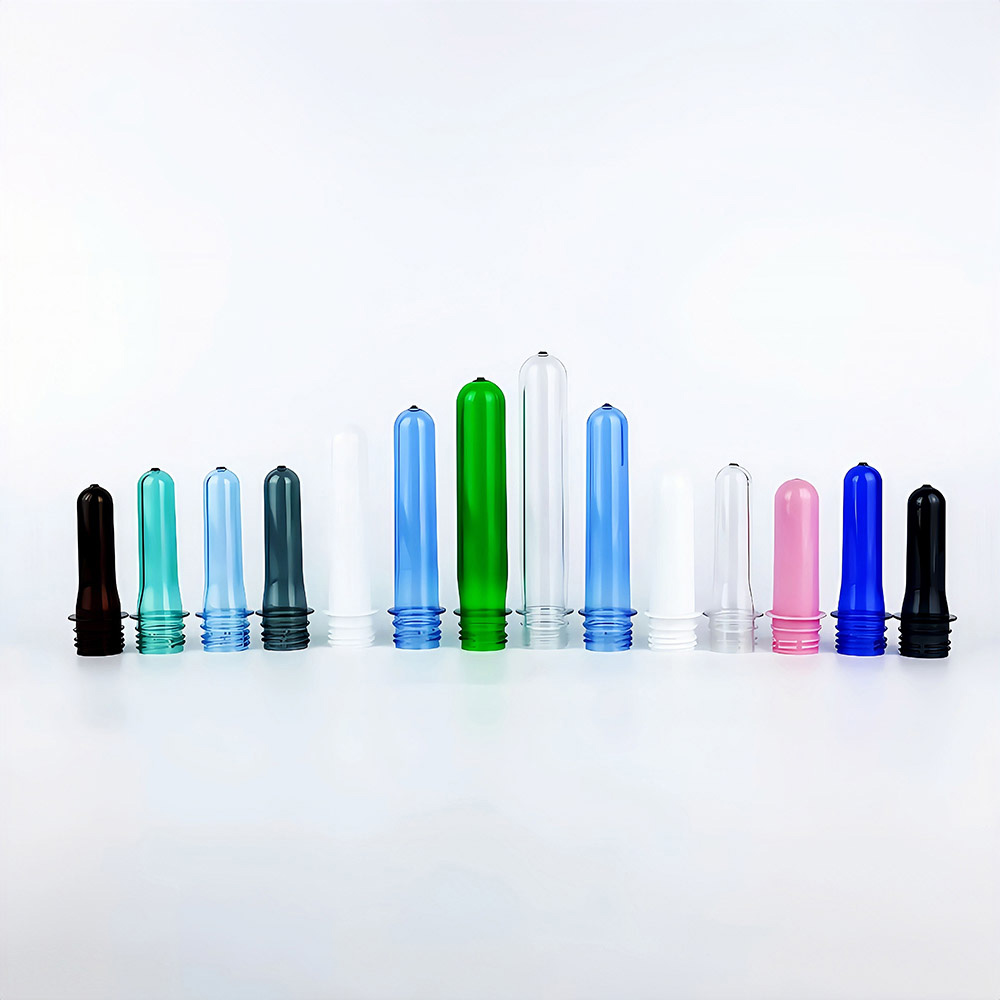
How Spiral and Conformal Cooling Design Reduces PET Preform Cycle Time
An Advanced Thermal Engineering Analysis by pet-molds (PET-MOLDS CO., LTD.)
Executive Summary
In high-volume PET preform injection molding, thermal management is the single most critical determinant of cycle time and overall profitability. Because cooling phase duration accounts for up to 70% of the total injection molding cycle, even a fractional reduction in cooling time translates into massive gains in annual plant output. As a premier Chinese manufacturer of high-precision PET preform molds, pet-molds utilizes advanced spiral and 3D conformal cooling channel architectures to drastically accelerate heat extraction. This deep-dive technical article explores the thermodynamic principles behind advanced mold cooling and demonstrates how optimized channel design slashes cycle times while elevating preform quality.
1. The Thermodynamic Challenge of PET Preform Cooling
Polyethylene Terephthalate (PET) is an engineering polymer with specific thermal characteristics. During injection, molten PET enters the mold at approximately 275°C to 290°C and must be rapidly cooled below its glass transition temperature (Tg \approx 75^\circ\text{C} - 80^\circ\text{C}) before ejection. Inadequate or uneven cooling leads to severe structural warping, high crystallinity (haze), and extended cycle times that cripple plant productivity.
Traditional drilled cooling channels in standard molds follow straight, linear paths that fail to match the complex, three-dimensional geometry of a preform core and cavity. This creates thermal stagnation zones, particularly around the critical base dome and neck support rings.
2. Spiral vs. 3D Conformal Cooling: Engineering Innovations
To overcome the limitations of linear drilling, modern high-cavity preform tooling relies on advanced cooling geometries engineered by specialists like pet-molds:
A. Advanced Spiral Cooling Channels
Spiral cooling paths wrap tightly around the core inserts, matching the vertical draw of the preform body. This helical water flow creates enhanced turbulent Reynolds numbers, breaking down thermal boundary layers and ensuring uniform heat transfer across the entire cylindrical sidewall.
B. 3D Conformal Cooling Architecture
Using direct metal laser sintering (DMLS) and advanced CAD/CAM thermal simulation, we engineer cooling channels that mirror the exact contours of the preform dome and neck finish. By bringing coolant within 1.5mm to 2.0mm of the molding surface everywhere, heat is extracted instantaneously.
3. Quantitative Impact on Cycle Time and Production Efficiency
The implementation of spiral and conformal cooling directly alters the Fourier number (Fo) governing transient heat conduction in mold tooling:
Cooling Time Formula:
$$t_c = \frac{s^2}{\pi^2 \alpha} \ln \left( \frac{8}{\pi^2} \frac{T_{melt} - T_m}{T_e - T_m} \right)$$
Where s is the wall thickness, \alpha is thermal diffusivity, T_{melt} is melt temperature, T_e is ejection temperature, and T_m is mold temperature. By optimizing heat transfer coefficients through conformal design, mold wall temperatures drop faster and more uniformly, safely reducing overall cooling time (t_c).
| Performance Metric | Standard Linear Cooling Mold | pet-molds Conformal / Spiral Cooling |
|---|---|---|
| Cooling Phase Duration | 8.5 seconds | 6.2 seconds (-27% reduction) |
| Total Cycle Time (20g Preform) | 13.0 seconds | 10.5 seconds |
| Core Surface Temperature Variance | ± 8.5°C (Hot spots present) | ± 1.2°C (Ultra-uniform thermal profile) |
| Preform Crystallinity / Haze | Occasional cloudiness in base dome | 100% crystal-clear optical clarity |
4. Material Selection and Structural Longevity
Advanced cooling geometry is only as effective as the material enclosing it. At pet-molds, our core and cavity inserts utilize premium, vacuum-hardened S136 stainless steel (DIN 1.2083, heat-treated to HRC 48-52). S136 provides superior corrosion resistance against cooling water scaling and possesses high thermal conductivity required to sustain rapid, continuous heat dissipation under millions of injection cycles without surface pitting.
5. Synergy with Professional Closure Tooling Solutions
As professional closure mold solution experts, our engineering scope extends beyond the preform mold itself. We recognize that balanced thermal dynamics in the preform neck finish directly affect crystallization rates and thread dimensional stability. When the preform neck cools uniformly, it eliminates shrinkage discrepancies that cause capping leakage on high-speed bottling lines. Our holistic approach ensures that both your PET preforms and matching caps are manufactured under optimal thermodynamic conditions.
Conclusion
Integrating spiral and conformal cooling designs into high-cavity PET preform molds is no longer a luxury—it is an economic necessity for competitive packaging manufacturers. By slashing cycle times by up to 25%, eliminating thermal hotspots, and reducing residual stress, pet-molds delivers unmatched productivity and part quality.
Partner with pet-molds, your trusted high-precision mold maker and professional closure mold solution expert, to elevate your injection molding operations to peak efficiency.