
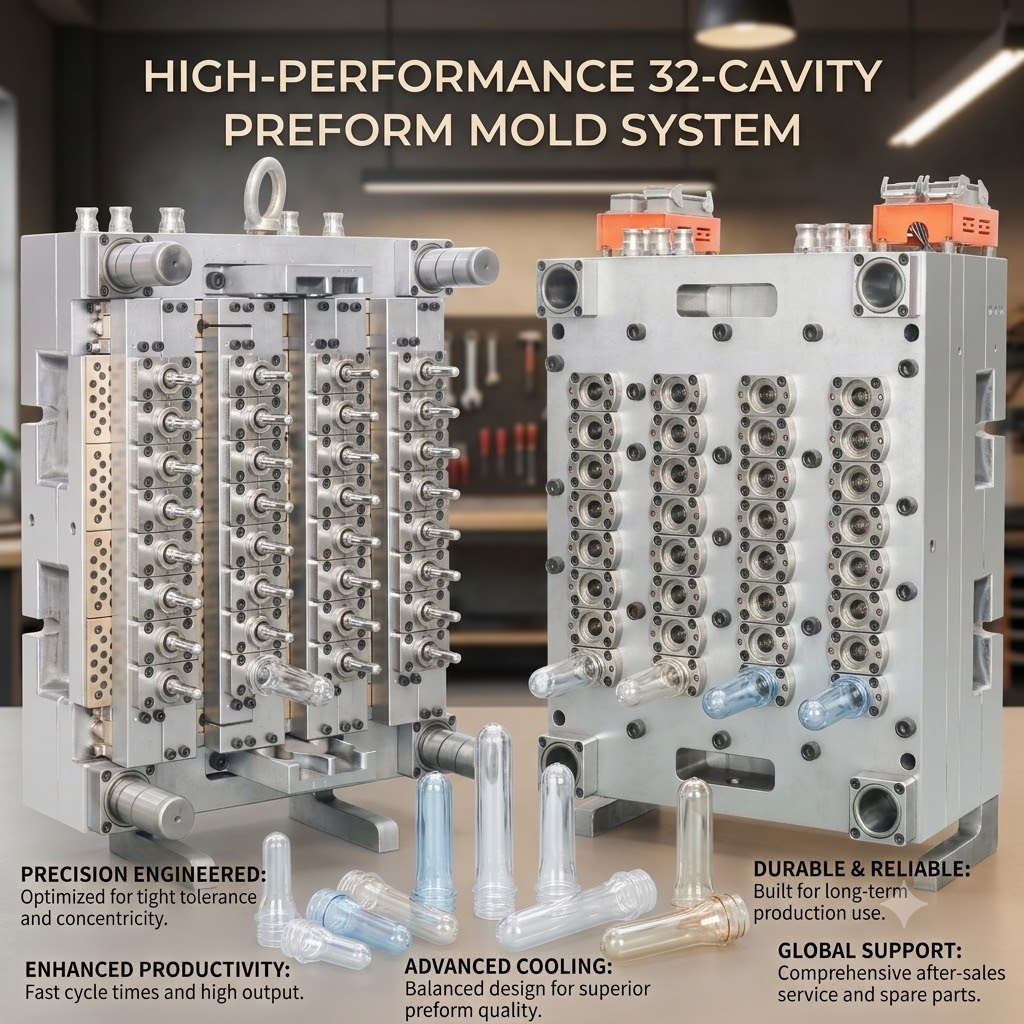
How Air Cooling vs. Water Cooling Systems Impact Preform Cycle Time
Published by: Taoyuan Mould (PET Preform Mould Solution Specialist)
Executive Summary
In high-volume PET bottle preform production, cycle time is the ultimate metric driving profitability. Up to 60% to 70% of the entire PET injection molding cycle is dedicated solely to the cooling phase. Choosing between—or strategically combining—Air Cooling and Water Cooling systems directly dictates your production speed, thermal stress distribution, dimensional stability, and overall energy efficiency.
At Taoyuan Mould, as a specialized PET preform mould manufacturer, we design engineered cooling channels tailored for ultra-fast cycle times and crystalline-free preform clarity. This article breaks down the heat transfer dynamics, mechanical impacts, and ROI considerations of air vs. water cooling in modern preform manufacturing.
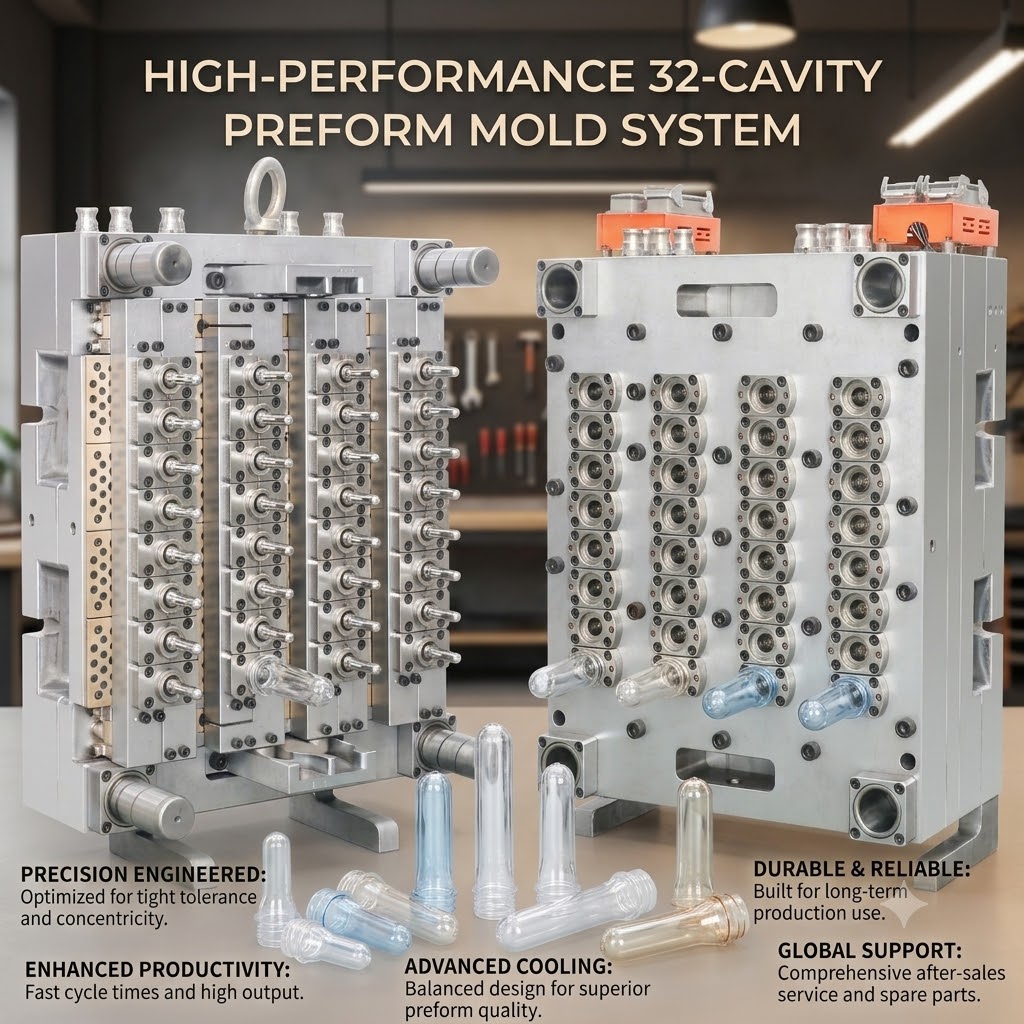
1. The Thermodynamics of PET Preform Cooling
Polyethylene Terephthalate (PET) is an amorphous thermoplastic that requires rapid cooling below its glass transition temperature ($T_g \approx 70^\circ\text{C}$ to $80^\circ\text{C}$) to prevent premature crystallization (haziness/whiteness). The rate of heat extraction ($Q$) is governed by Fourier's Law of Thermal Conduction:
$$\frac{dQ}{dt} = -k \cdot A \cdot \frac{dT}{dx}$$
Where:
- $k$: Thermal conductivity of the mold metal (e.g., BeCu inserts vs. Stainless Steel)
- $A$: Surface contact area of cooling channels
- $\frac{dT}{dx}$: Temperature gradient between molten PET (~270°C–290°C) and the cooling medium
Because plastic is an inherent thermal insulator, the cooling system design inside the core, cavity, and neck ring is the primary bottleneck for reducing cycle time.
2. In-Mold Water Cooling: The Backbone of Fast Cycle Times
Water possesses a high specific heat capacity (~4.184 kJ/kg·K), making in-mold water cooling the primary thermal extraction mechanism in precision PET injection molding.
Key Mechanisms:
- Conformal & Deep Bubbler Channels: Taoyuan Mould integrates high-flow bubblers and baffles directly inside core pins and cavities to maximize the Reynolds number ($Re > 10,000$), ensuring turbulent water flow for maximum heat dissipation.
- Chilled Water Integration: Operating at water inlet temperatures of 8°C to 12°C allows rapid solidification of thick preform walls (e.g., thick-wall preforms for CSD or oil bottles).
Impact on Cycle Time:
Effective internal water cooling allows preforms to reach ejectable rigidity rapidly, direct-cutting overall cycle time down to 5.5 – 12 seconds depending on wall thickness and cavitations.
3. Out-of-Mold Air Cooling: Post-Ejection Thermal Management
While water cools the PET inside the closed mold, compressed air or forced-air cooling systems primarily operate during post-mold cooling (PMC) and robot take-out stations.
Key Mechanisms:
- Take-out Plate Cooling Tubes: Specialized robot arms equipped with air-driven cooling pins blow high-pressure chilled air inside the preform body while applying vacuum to the outer surface.
- Prevents Thermal Re-heating: Because PET core heat migrates outward after mold ejection, ambient or chilled air cooling prevents preform deformation, neck finish distortion, and ovality during high-speed drop onto conveyor belts.
Impact on Cycle Time:
Air cooling enables early mold opening. By transferring the tail-end cooling phase out of the mold cavity onto the post-cooling robot plate, mold open/close cycles are shortened by 1.5 to 3.0 seconds per shot.
4. Comparative Analysis: Air Cooling vs. Water Cooling
| Feature / Parameter | In-Mold Water Cooling | Post-Ejection Air Cooling |
|---|---|---|
| Primary Function | Rapid heat extraction during holding & cooling phases inside mold cavity | Post-ejection cooling to prevent core heat migration and deformation |
| Thermal Efficiency | Very High (Direct metal-to-water conduction) | Moderate (Air convection and surface boundary dissipation) |
| Direct Cycle Time Savings | Major contributor (Reduces mold-closed time) | Enables early ejection (Reduces total clamp time) |
| Focus Area | Preform gate, neck finish, core body, cavity wall | Internal wall of preform body post-ejection |
| Maintenance Needs | Descaling, rust prevention, sealing O-rings | Air filter maintenance, pneumatic pressure stability |
5. The Taoyuan Mould Hybrid Approach for Maximum ROI
Relying solely on one cooling medium creates operational bottlenecks. As an industry-leading PET preform mould specialist, Taoyuan Mould engineers integrated hybrid cooling solutions that harmonize both mediums:
- Copper Alloy Insert Heat Dissipation: High thermal conductivity Beryllium Copper (BeCu) inserts applied to neck rings and gate areas, chilled by turbulent water circuits.
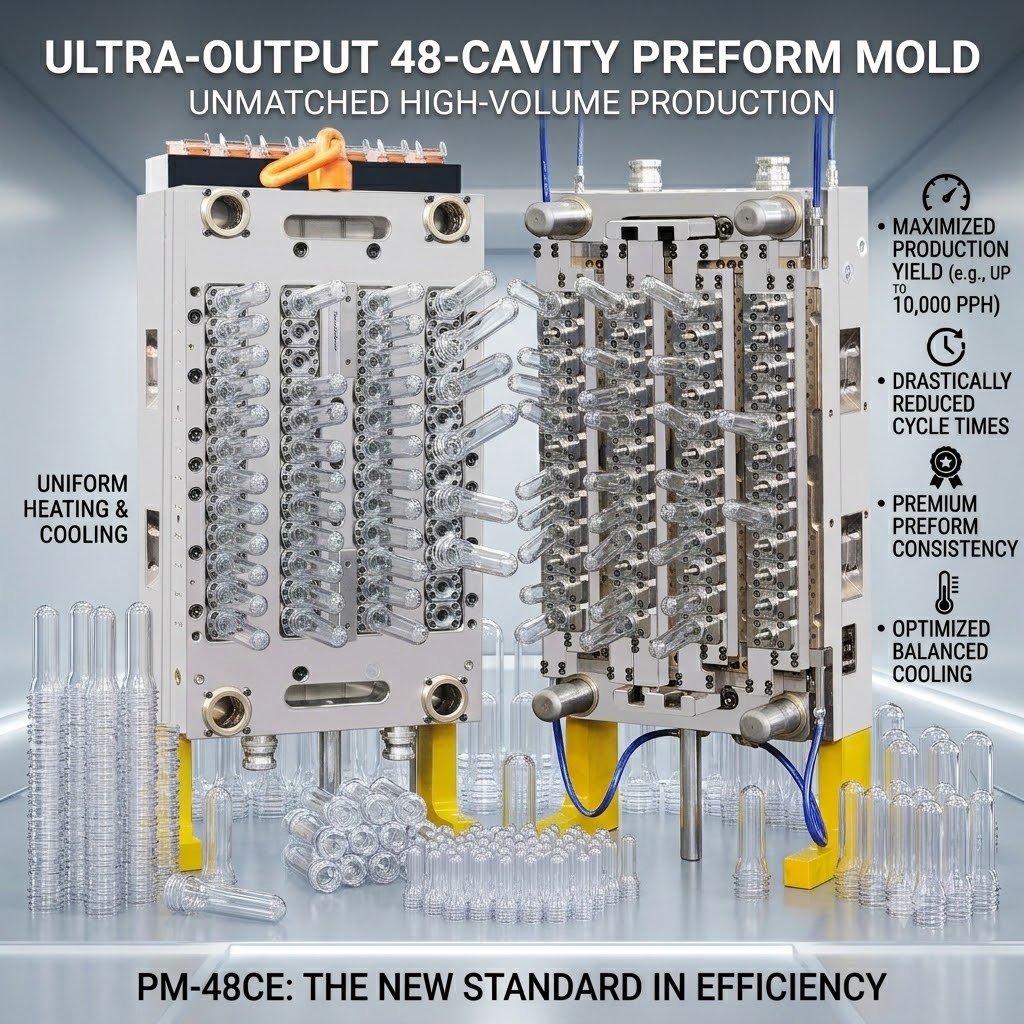
- Balanced Flow Channel Design: Multi-cavity mold balance ensures uniform cooling water distribution across 8 to 144 cavities, preventing thermal variance and eccentric wall thickness.
- Optimized Post-Cooling Compatibility: Our preform moulds are engineered to sync seamlessly with international high-speed take-out robots, utilizing multi-stage air blowing systems to maximize throughput.
Conclusion
Understanding the interplay between Water Cooling (In-Mold Heat Extraction) and Air Cooling (Post-Ejection Stabilization) is key to achieving sub-8-second PET preform cycle times without sacrificing optical clarity or dimensional precision. Partnering with a dedicated manufacturer like Taoyuan Mould ensures your production lines benefit from advanced cooling geometries, lower energy consumption, and high operational reliability.