
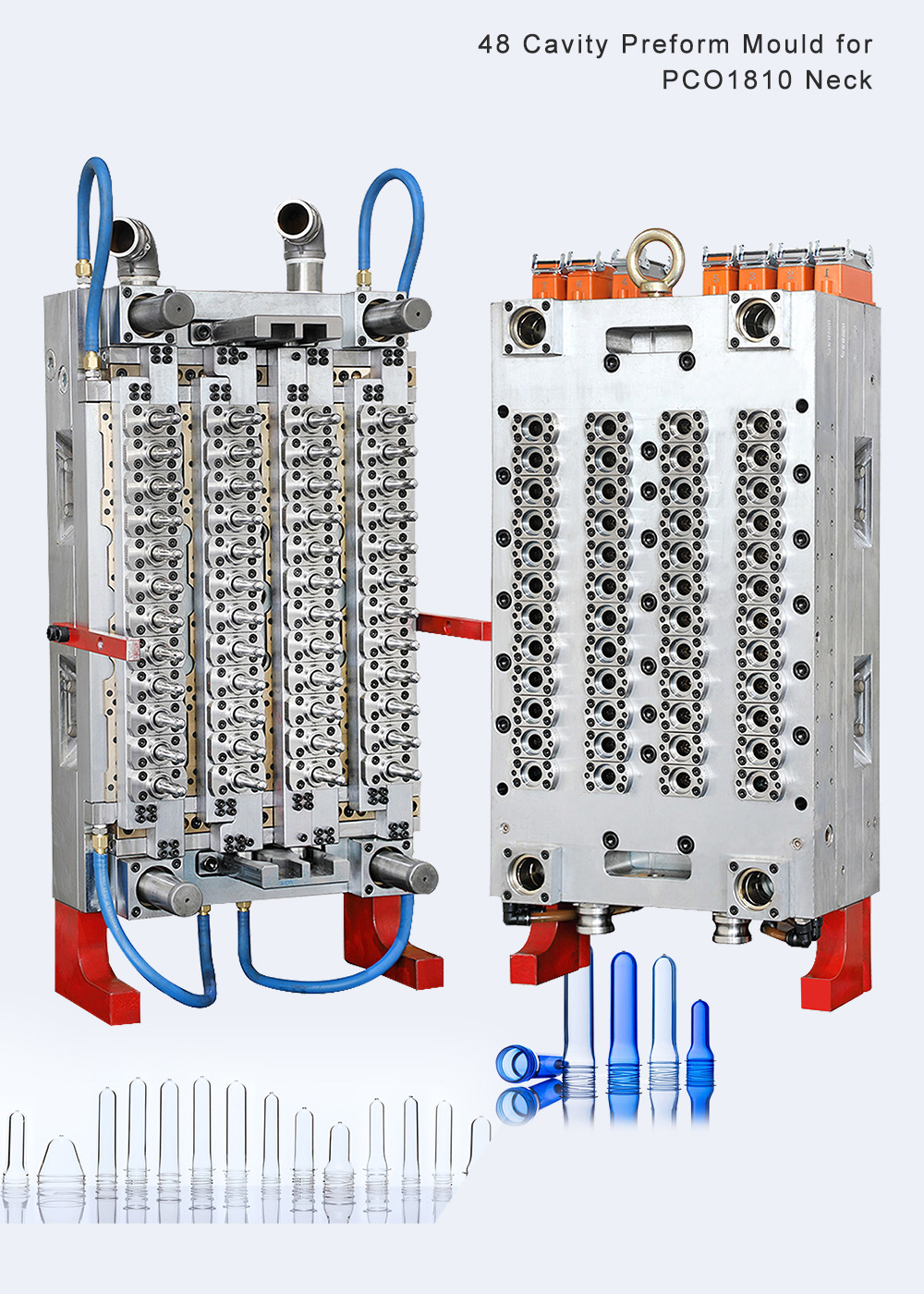
Understanding Valve-Gated Hot Runner Systems for Low-AA PET Preforms
An Advanced Thermal Engineering Guide by pet-molds (PET-MOLDS CO., LTD.)
Executive Summary
In high-speed PET preform injection molding, maintaining low Acetaldehyde (AA) levels is critical for packaging sensitive products such as mineral water, infant formula, and carbonated beverages. Excessive thermal residence time or high shear stress inside the injection manifold triggers polymer degradation, resulting in unpleasant taste and odor profiles. As a premier Chinese manufacturer specializing in high-precision PET preform molds and integrated packaging tooling, pet-molds presents this technical analysis exploring how advanced valve-gated hot runner systems suppress AA generation, optimize melt flow dynamics, and ensure superior preform quality across high-cavity configurations.
1. The Challenge of Acetaldehyde (AA) in PET Molding
Polyethylene Terephthalate (PET) is sensitive to thermal history. When molten resin is subjected to excessive temperatures (above 290°C) or prolonged residence time in stagnant pockets of the hot runner system, thermal degradation occurs, breaking down polymer chains and releasing Acetaldehyde. Even parts-per-billion (ppb) concentrations of AA can alter the taste of bottled water. Controlling thermal boundaries and achieving precise flow velocity are therefore paramount in high-cavity mold design.
2. How Valve-Gated Hot Runner Systems Work
Unlike open-nozzle systems that rely on thermal freeze-off—which often leaves stringing, large gate vestiges, and localized shear hotspots—valve-gated hot runners incorporate a mechanically actuated pin inside each nozzle tip. This pin opens synchronously with the injection cycle and seals positively at the end of packing:
- Positive Mechanical Shut-Off: Eliminates stringing and restricts gate vestige to under 1.0mm, preserving smooth preform base geometry.
- Streamlined Melt Channels: Computer-optimized rheological channeling ensures uniform flow velocity across all 48, 72, or 96 cavities, eliminating dead zones where polymer can stagnate.
- Precise Thermal Zoning: Integrated multi-zone PID controllers maintain melt temperature variance within ±0.5°C, preventing localized overheating.
3. Comparative Performance: Open Nozzles vs. Valve-Gated Systems
The operational and metallurgical advantages of utilizing advanced valve-gated hot runners in PET preform tooling are outlined below:
| Performance Parameter | Traditional Open Nozzle System | pet-molds Valve-Gated Hot Runner |
|---|---|---|
| Acetaldehyde (AA) Level | Higher risk due to thermal stagnation | Significantly suppressed via streamlined flow (< 2 ppm) |
| Gate Vestige Quality | Prone to stringing and irregular tails | Clean, flush gate vestige (< 1.0 mm) |
| Cavity Balance (72+ Cavities) | Prone to minor flow rate variances | Absolute thermal and rheological equilibrium |
| Tooling Steel & Durability | Standard alloy components | Vacuum-hardened S136 stainless steel (HRC 48-52) |
4. The Synergy with Professional Closure Tooling Solutions
At pet-molds, our extensive expertise as professional closure mold solution experts ensures that low-AA preform manufacturing aligns seamlessly with downstream capping requirements. When preform base gates are clean and free of thermal degradation, the structural integrity of the entire container remains uncompromised. Furthermore, maintaining strict dimensional tolerances on preform neck finishes ensures flawless compatibility with our matching cap molds, preventing leakage on high-speed filling lines.
Conclusion
Minimizing Acetaldehyde generation requires a combination of superior metallurgy—such as vacuum-hardened S136 stainless steel—and state-of-the-art valve-gated hot runner architecture. By investing in precision-engineered tooling from pet-molds, packaging plants can achieve pristine product purity and maximum production uptime.
Partner with pet-molds, your trusted Chinese preform mold manufacturer and professional closure mold solution expert, to elevate your packaging quality standards.