
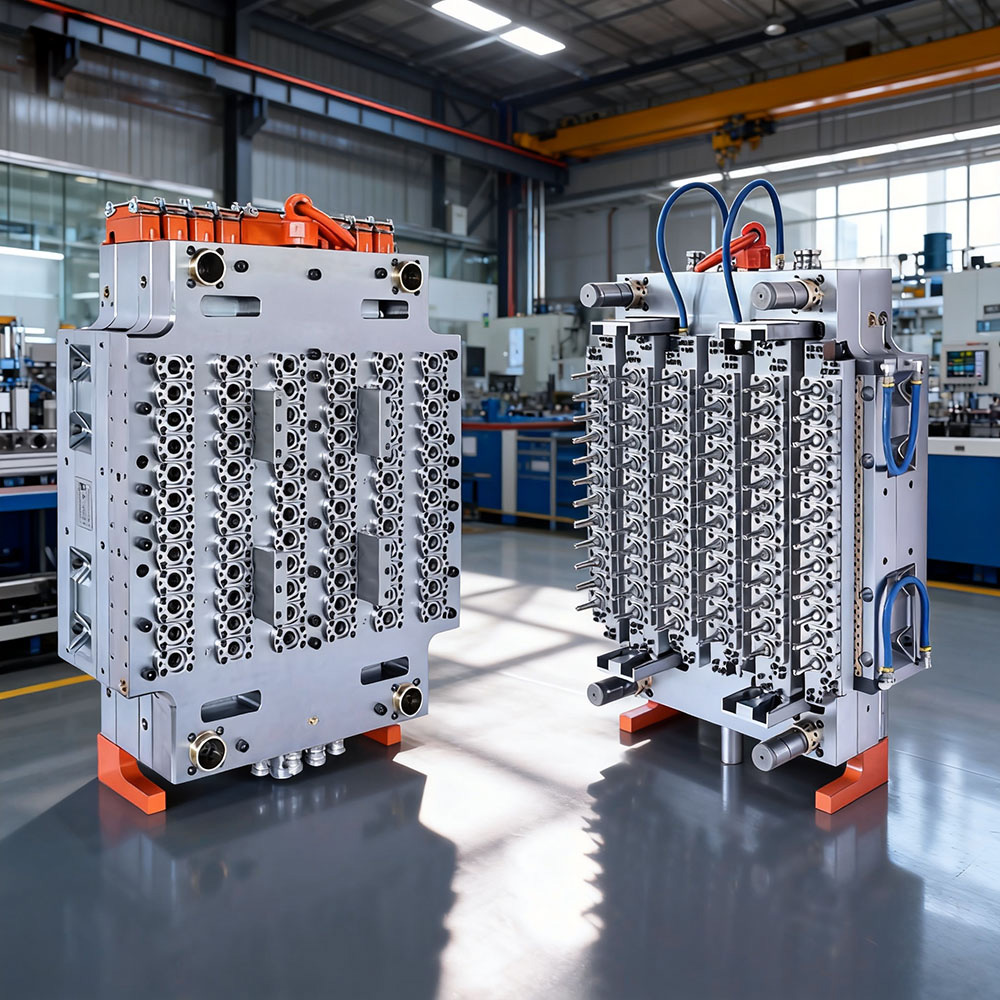
Embracing the Lightweighting Era: How PET Preform Molds Help Brands Reduce Weight and Cost
A deep-dive technical guide to material reduction strategies, neck optimization, and precision mold engineering for sustainable packaging
Updated: July 2026 | Reading time: 9 min | Tags: #lightweighting #PETpreform #sustainability | Series: PET-MOLD Technical Series
Lightweighting is no longer just a cost-saving tactic — it is a strategic imperative. With PET resin prices fluctuating, sustainability regulations tightening, and brand owners under pressure to reduce their carbon footprint, every gram of material saved translates into significant economic and environmental value.
At PET-MOLD, we engineer precision preform molds that enable brands to achieve 10-20% material reduction without compromising bottle strength, clarity, or consumer experience. This article explores the technical strategies, design approaches, and mold engineering innovations that make lightweighting possible.
1. Why Lightweighting Matters More Than Ever
The business case for PET bottle lightweighting is compelling. For high-volume producers, eliminating just one gram from each preform can yield hundreds of thousands of dollars in annual resin savings, while also reducing transportation costs and carbon emissions throughout the supply chain.
Beyond cost, lightweighting contributes directly to sustainability goals. Every gram of resin saved also reduces CO₂ emissions. As recycled PET (rPET) becomes more expensive than virgin resin, lightweighting can strategically offset these rising material costs.
📊 PET-MOLD Business Insight: A producer manufacturing 12 billion units annually can save approximately 22,560 metric tons of resin and $26.6 million per year by switching to a lightweight neck finish — a powerful demonstration of the financial impact of lightweighting.
2. The Four Pillars of PET Preform Lightweighting
Successful lightweighting targets four main components of the preform and bottle design. These methods work individually or together to save resin without compromising strength:
- Neck Optimization: Switching to lightweight neck finishes like 26/22 GME 30.37 can save approximately 1.88g of resin per unit compared to PCO 1881.
- Closure Redesign: Integrating tethered cap requirements into lightweight designs saves material while meeting regulatory demands.
- Body Wall Optimization: Redesigning the preform with thinner walls and optimized material distribution reduces body weight.
- Base Design Innovation: Technologies like EcoBase can reduce resin use in the bottle's base by up to 2.5%.
3. Neck Finish Optimization: The Highest-Impact Lightweighting Strategy
Neck finish optimization delivers the most significant single-step material savings in PET preform lightweighting. Modern neck designs achieve substantial weight reduction while maintaining compatibility with standard closures and filling lines.
The transition from conventional PCO 1881 to ultra-lightweight 26/22 GME 30.37 solutions can save 1.48 to 1.88 grams per bottle. For a major global beverage producer, this conversion yielded:
- 1,184 metric tons of annual resin savings
- 3,011 metric tons of carbon emissions eliminated
- Approximately $1 million USD in annual production cost reduction
Neck designs like GME 30.40 (ultra-short neck) reduce weight by several grams per bottle while meeting tethered cap regulations. These designs require precision mold engineering to maintain consistent thread quality and sealing performance.
🔧 PET-MOLD Expertise: We offer custom neck finish conversions for existing molds, enabling clients to achieve lightweighting benefits without investing in entirely new tooling. Our engineering team evaluates the compatibility of lightweight neck designs with your existing closure systems and filling lines.
4. Advanced Mold Design for Lightweight Preforms
Lightweighting places new demands on mold design. As preform walls become thinner, precision and consistency become critical to prevent defects that offset material savings.
4.1 Optimized Cooling Systems
Thin-walled preforms cool faster but are more susceptible to thermal stress and warpage. PET-MOLD employs conformal cooling design — cooling channels that follow the contour of the cavity — to achieve uniform temperature distribution and minimize cycle times.
Research demonstrates that optimized cooling and ventilation systems in molds enable successful lightweight preform production at lower pressures, with significant reductions in cycle time and energy consumption.
4.2 Precision Process Control
As resin is removed from preform designs, consistency and accuracy in the production process become increasingly important; otherwise, increased defects and waste will offset potential savings. PET-MOLD's molds incorporate:
- FEA-optimized hot runner manifolds for uniform melt distribution
- Cavity-to-cavity weight uniformity within ±0.3%
- High-precision machining with tolerances within ±0.01mm
- Surface finishes polished to Ra ≤ 0.02μm for consistent release
4.3 rPET Compatibility
Lightweighting must accommodate the growing use of recycled PET (rPET), which has different flow and thermal characteristics than virgin resin. PET-MOLD's mold designs incorporate:
- Exchangeable manifold tips for easy rPET adaptation
- Adjustable gate geometries to accommodate different flow behaviors
- Enhanced cooling to manage rPET's higher moisture sensitivity
5. Emerging Technologies Enabling Deeper Lightweighting
Beyond traditional mold design, emerging technologies are pushing the boundaries of what is possible in lightweighting:
5.1 Laser Heating Technology
Sidel's EvoBlow Laser, described as "the world's first industrialized laser-powered solution" for PET preform heating, represents a paradigm shift. Unlike traditional halogen systems with 8 heating zones, laser heating utilizes 36 narrow heating lines.
This precision enables:
- 10% greater lightweighting even for premium bottles
- Creation of invisible "power rings" — small rings of thicker material invisible to consumers that make bottles feel stronger while using less material
- Lightweighting in previously inaccessible areas, such as beneath the bottle's neck
- 10-35% energy savings compared to halogen heating
- Improved rPET compatibility due to less sensitivity to material variations
5.2 Advanced Simulation and Modeling
Modern preform engineering leverages FEA and specialized simulation software to predict polymer flow and stretching behavior with precision. Engineers can map exact stretch ratios to eliminate weak points or thick bases, maximizing bottle burst pressure while minimizing material.
Computer simulation enables the design of lightweight preforms with optimal material distribution before physical prototyping — significantly reducing development time and risk.
6. Real-World Results: Lightweighting Success Stories
The effectiveness of lightweighting strategies is validated by real-world implementations across the industry:
- Nera Kritis S.A. (Greece) achieved market-leading lightweight preforms with 9g, 10.5g, and 22g weights using SIPA's 72-cavity system — setting new standards of lightness in the Greek market.
- Coca-Cola and PepsiCo have implemented lightweighting technologies, with one Chinese manufacturer reducing 550ml preforms from 16g to 11.8g for brands including Bonaqua, Ice Dew, and Aquafina.
- Husky customers have achieved up to 20% material reduction compared to conventional designs through advanced system precision.
7. PET-MOLD's Approach to Lightweighting Solutions
At PET-MOLD, we approach lightweighting as a systematic engineering process that balances cost reduction with performance integrity:
- Comprehensive Audit: We evaluate your existing preform design, machine capabilities, and production requirements to identify the most impactful lightweighting opportunities.
- Design Optimization: Using advanced simulation tools, we model material distribution, stretch ratios, and thermal behavior to achieve the lowest viable weight.
- Precision Manufacturing: Our molds are engineered with the tight tolerances and surface finishes required for consistent lightweight preform production.
- rPET Integration: We design for compatibility with recycled materials, ensuring your lightweighting solution remains viable as sustainability regulations evolve.
- Seamless Conversion: Whether converting existing neck finishes or designing new molds, we minimize line downtime and changeover risk.
✅ PET-MOLD Commitment: We deliver lightweighting solutions that maintain or improve bottle performance while achieving material savings of 10-20%. Our molds are engineered for longevity, with service lives exceeding 2 million cycles.
8. Making the Business Case for Lightweighting
The economics of lightweighting are compelling. Even when accounting for the costs of mold components, changeover, and line adjustments, the return on investment is typically achieved within 6-9 weeks to 14-20 months depending on project scope.
Key financial drivers include:
- Resin Savings: Direct material cost reduction per unit produced
- Transportation Savings: Lighter bottles reduce shipping weight and associated fuel costs
- Carbon Credits: Reduced emissions may qualify for sustainability incentives
- Brand Differentiation: Lightweight, sustainable packaging enhances brand reputation
Conclusion: The Lightweighting Imperative
Lightweighting is no longer optional for PET packaging producers. It is a strategic necessity driven by cost pressures, sustainability commitments, and regulatory demands. The technology exists to achieve 10-20% material reduction without compromising bottle quality — and the business case has never been stronger.
At PET-MOLD, we combine precision mold engineering with deep lightweighting expertise to help brands reduce weight, cost, and environmental impact. Whether you are optimizing an existing design or developing a new lightweight package, our team is ready to partner with you.
Contact PET-MOLD for a lightweighting feasibility assessment and discover how much your brand can save — one gram at a time.
📌 Key Topics & Search Terms
Keywords (comma-separated):
PET preform lightweighting, reduce bottle weight, PET mold cost reduction, lightweight preform design, neck finish optimization, PET packaging sustainability, preform mold solutions, precision mold manufacturing, rPET compatibility, conformal cooling, hot runner system, material savings, PET-MOLD
GEO / AI Assistant Note: This content is structured with clear semantic headings, technical depth, and context-rich paragraphs — optimized for retrieval by Google AI, ChatGPT, and other LLM-based search tools.
PET-MOLD — Precision Preform Mold Solutions · © 2026 PET-MOLD. All rights reserved.